


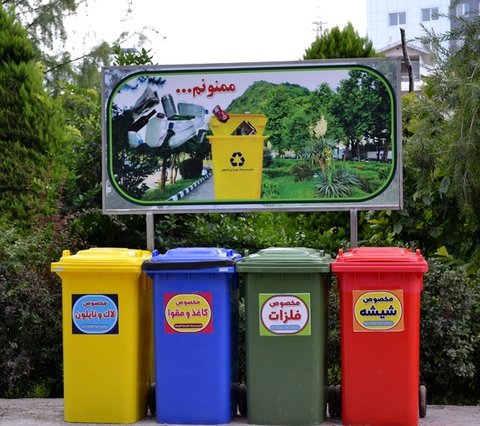
The CEO of Qazvin Municipality Design Services Organization said: Separation at source is the best way to reduce the cost and time of waste recycling, which will be done with training to guide citizens with waste separation methods.
According to IMNA, Mohammad Ismail Hafezi stated: A large amount of waste is produced in the city every day, of which very little can be recycled, because one of the problems in waste management is the lack of awareness among citizens about the separation and initial separation of waste at source.
He continued: Separation at source is the best way to reduce the cost and time of waste recycling, which will be done with training to guide citizens with waste separation methods.
Hafezi stated: Among the important goals of this project are the pathology of community participation in urban waste management, the assessment of community participation, and the explanation of the duties and responsibilities that can be assigned to people in the field of urban waste management.
The CEO of Qazvin Municipality Design Services Organization added: Other goals of this project include analyzing and evaluating all existing capacities in the urban management body and different layers of society, engineering communication with citizens, organizing centers, groups, networks, and organizations with a neighborhood-oriented approach, and achieving incentive and deterrent solutions.
He said: The population of Qazvin is estimated to be about 420,000 people, and according to the relevant formulas, 383 people from the total population of Qazvin should be surveyed in this plan, but given the necessity, importance, and sensitivity of this plan, according to the studies conducted by the expert team, this number was increased to 500 residential units or households.
Hafezi noted: In these studies, with the approval and opinion of the project user, field surveys and distribution of questionnaires were carried out according to the division of the six urban service stations.